What Does EV Stand for in Cars? Definition & Types
If I had a dollar for every time a customer rolled into my bay and asked, “So, is this a real electric car or just a hybrid?” I’d have retired to a beach house years ago. The badge on the trunk says “Electrified,” the salesman said “EV,” but there is a gas cap on the side. Confusion is standard equipment these days.
In my twenty years of wrenching, starting with greasy V8s and moving to high-voltage orange cables, I’ve seen “EV” evolve from a niche science experiment into a dominating force. But the term “EV” (Electric Vehicle) has become a catch-all bucket that marketing teams throw everything into. As a mechanic, I don’t look at marketing; I look at drivetrains.
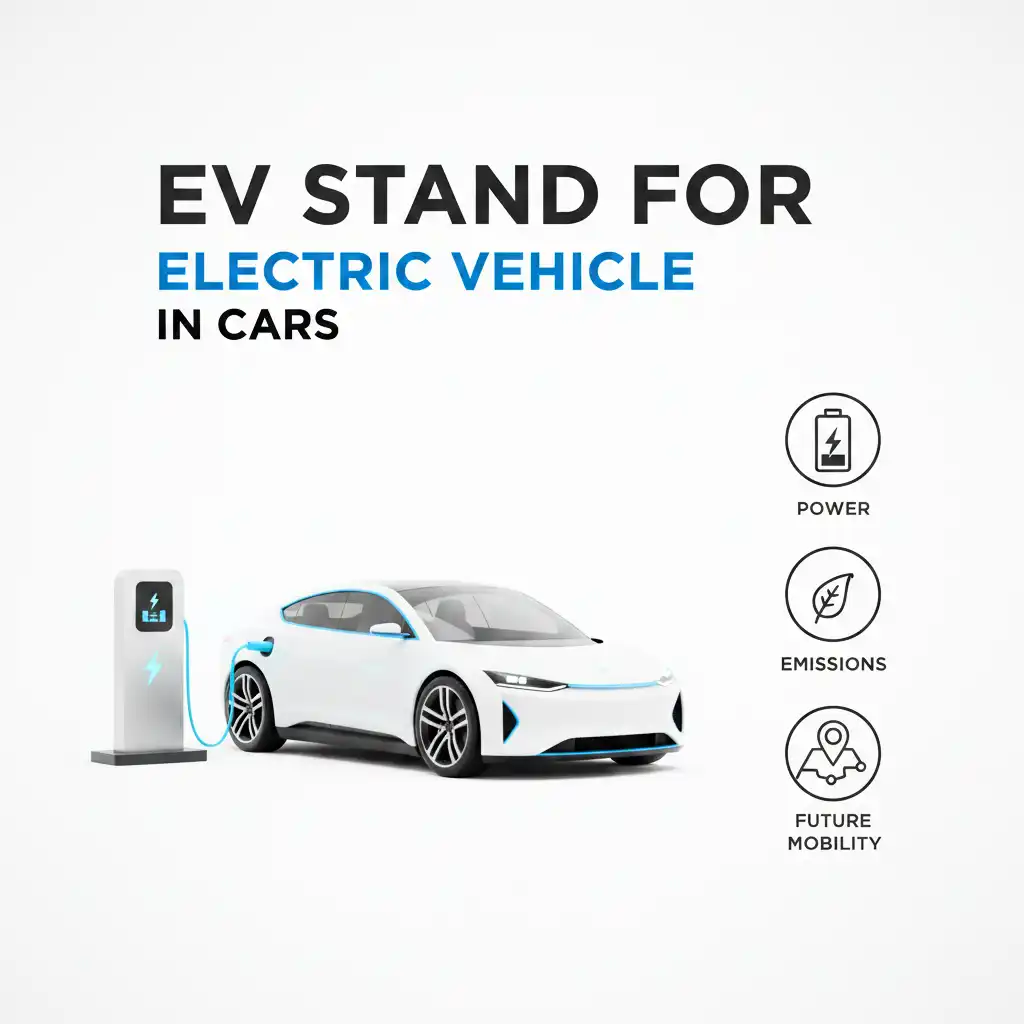
Technically, EV stands for Electric Vehicle, which broadly defines any vehicle that uses an electric motor for propulsion. But that is like saying “pasta” when you specifically mean “lasagna.” Under the hood, the differences are massive. Let’s pop the latch and break down the “Electric Alphabet Soup” (BEV, PHEV, HEV, FCEV), so you know exactly what you are buying and what I’ll eventually have to fix.
BEV: The “Pure” Electric (Battery Electric Vehicle)
When you think of Tesla, Rivian, or the Ford Lightning, you are thinking of a BEV. This is the purest form of the technology. There is no gas tank, no muffler, and no pistons moving up and down.
The Mechanic’s Perspective: Driving a BEV feels like being launched by a giant rubber band. You step on the pedal, and the torque is instant—there is no transmission “hunting” for gears. In the shop, these are a different beast. When I lift a BEV, I have to be surgically precise with my lift points because the entire floor is a massive, heavy battery pack. If I miss by an inch, I could crush a cooling line or the battery casing itself, totaling a $20,000 component.
Sensory Details:
- Sound: It’s not silent. At low speeds, you’ll hear a synthetic “spaceship” hum required by law to warn pedestrians. When you really step on it, there is a high-pitched whine from the inverter, similar to a camera flash charging up but louder.
- Feel: The strangest sensation is “One-Pedal Driving.” When you lift off the accelerator, the electric motors turn into generators (regenerative braking), dragging the car to a stop. It feels like driving a boat through thick syrup.
PHEV: The Bridge (Plug-In Hybrid Electric Vehicle)
This is the “best of both worlds” or the “worst of both worlds,” depending on how you use it. A PHEV (like the Toyota RAV4 Prime or Jeep Wrangler 4xe) has a gas engine and a decently sized battery with a charge port. You can drive 20-40 miles on pure electricity before the gas engine kicks in to save you.
The Mechanic’s Perspective: These are complex machines. I often see PHEVs come in with “maintenance anxiety.” Owners forget that even if they drive mostly on electricity, the gas in the tank goes stale (turns to varnish) after six months. The computer will eventually force the engine to run just to burn off the old fuel. Mechanically, you have two complete powertrains to maintain: an engine that needs oil changes and a high-voltage system that needs coolant flushes.
Sensory Details:
- The Hand-Off: You will feel a distinct shudder when the battery drains and the gas engine wakes up. It’s rarely seamless. One minute you are gliding silently; the next, a cold, thrashy 4-cylinder engine roars to life at 3,000 RPM to carry the load.
HEV: The Classic Hybrid (Hybrid Electric Vehicle)
Think Toyota Prius. You cannot plug this car in. The battery is tiny—barely enough to move the car across a parking lot. The electricity is generated entirely by the gas engine and regenerative braking.
The Mechanic’s Perspective: I call these “gas cars with an electric turbo.” The electric motor is just there to help the gas engine be lazy. They are incredibly reliable because the battery is never deeply discharged. However, don’t let anyone tell you these are “EVs” in the modern sense. They are efficient gas cars. The most common repair I see? The high-voltage battery cooling fan gets clogged with dog hair from the back seat, overheating the battery and throwing a “Check Hybrid System” code.
FCEV: The Science Project (Fuel Cell Electric Vehicle)
The Toyota Mirai or Hyundai Nexo falls here. These use hydrogen gas to generate electricity on the fly. There is no battery to plug in; you fill a tank with compressed hydrogen.
The Mechanic’s Perspective: Unless you live in specific parts of California, you will likely never see one. They are technically EVs because an electric motor drives the wheels, but the power source is a chemical stack. They emit nothing but water. Literally, there is an “H2O” button on the dashboard to purge the exhaust pipe, and it pees a cup of warm water onto the driveway.
How EVs Power Their Hearts: Batteries, Motors, and Controllers
When you hear the soft, almost inaudible whirring of an electric motor, you’re listening to the heart of an EV. My toolbox is littered with torque wrenches for tightening those 19‑mm drive bolts on an inverter, and I’ve sat at a bench reading the datasheet for a 90 kWh pack when new models roll out. The three main players are:
Battery Pack:
- Usually Lithium‑ion (Li‑ion) cells stacked into modules.
- Each packet contains tens of thousands of cells, arranged to achieve the required energy (often 70–100 kWh now).
- They are housed in a reinforced chassis‑mounted package at the car’s lowest point for stability.
- Typical capacities for new models are often 60‑120 kWh.
- A rough rule of thumb: 1 kWh yields about 3 miles of range on a 250‑hp car.
Electric Motor:
- Most modern cars use a permanent‑magnet synchronous motor or an induction motor.
- They convert electrical energy into mechanical energy via magnetic fields.
- The power can range from 80 kW (≈108 hp) for a city commuter to 350 kW (≈470 hp) for a sports sedan.
- You’ll hear a high‑frequency whine when you press the accelerator, unlike the low‑pitched growl of a combustion engine.
Power Electronics (inverter & controller):
- The inductor board turns the bus‑level DC into AC of variable frequency and voltage.
- The controller manages battery thermal conditions, traction control, regenerative braking, and drives.
- I once had to swap a controller board that had overheated after a prolonged fast‑charge session. The smell of burnt plastic was a warning that the cooling system needed a review.
All three components communicate over CAN bus, and the entire system is monitored by the car’s ECU through over a thousand sensor inputs. A fault in the battery management system (BMS) almost always triggers a loss of performance, a situation every skilled mechanic learns to diagnose quickly.
The Sounds and Smells of High Voltage
One of the top searches I analyze is “Is my electric car making weird noises?” As a mechanic, I have had to relearn my diagnostics because the sounds have changed.
- The Clunk-Clack at Startup: When you press the power button, you will hear a loud, heavy metallic thunk from under the rear seat or floor. That is the High Voltage Contactor. It’s a massive switch closing to connect the 400-volt (or 800-volt) battery to the rest of the car. If you don’t hear that clack, you aren’t going anywhere.
- The Smell of Sweet vs. Chemical: If a gas car leaks coolant, it smells like maple syrup. If an EV leaks coolant, it might smell totally different. Many EVs use Low-Conductivity (Dielectric) Coolant. It smells sharper, almost metallic. If you smell ozone (like a thunderstorm) inside the cabin, pull over immediately. This could indicate a high-voltage insulation fault or arcing.
The Brutal Truth About Maintenance-Free
A huge search trend is “Do EVs need oil?” No, they don’t have engine oil. But if you think they are maintenance-free, you are dreaming.
- Tires: EVs eat tires for breakfast. The instant torque and the extra 1,000 lbs of battery weight chew through rubber 30% faster than gas cars. I see peculiar wear patterns on the inner edges of tires because the heavy suspension geometry has aggressive camber.
- 12-Volt Battery: Yes, EVs still have a regular little car battery to run the lights and radio. And it is the #1 cause of breakdowns. When it dies, the big computer can’t wake up the big battery, and your $60,000 spaceship is bricked.
- Reduction Gear Oil: There is a “transmission” of sorts—a single-speed gearbox. Manufacturers often claim the fluid is “lifetime.” I’m telling you now: change it at 50,000 miles. I’ve drained “lifetime” fluid that looked like metallic glitter paint.
Understanding what “EV” stands for is more than just knowing an acronym. It’s knowing whether you are signing up for oil changes, tire rotations every 5,000 miles, or hunting for hydrogen stations. Choose the drivetrain that fits your life, not just the one with the coolest badge.