Do Electric Cars Need Transmissions? The Ultimate Guide
So, where’s the dipstick for the transmission?
It’s a question I hear at least once a week from new electric vehicle (EV) owners peering under the hood or “frunk” of their shiny new purchases. They are used to checking amber fluids, worrying about clutch packs, and feeling the rhythmic thud of a downshift when merging onto the highway. When I tell them their car technically has a transmission, but it doesn’t shift gears, they usually look at me like I’ve just spoken Latin.
As a mechanic who has spent 20 years rebuilding everything from Ford C4 three-speeds to modern CVT nightmares, I can tell you that the transition to electric drive units is the biggest mechanical shift I’ve seen. The short answer is yes, electric cars absolutely need transmissions. But they don’t need the complex, hydraulic-filled, valve-body-jammed boxes you are used to. They use something elegant, deceptively simple, and often misunderstood called a Single-Speed Reduction Gear. Let’s pop the case open and see what’s actually spinning between your motor and your wheels.
Why Gas Engines Are Needy
To understand why your EV transmission is so simple, you have to understand why your gas car’s transmission is so complicated. An internal combustion engine (ICE) is a bit of a diva. It only makes useful power in a very narrow window, usually between 2,000 and 6,000 RPM. If you are below that, the engine stalls. If you go above that, it explodes. To keep the engine in that “happy place” while the car goes from 0 to 100 mph, you need gears, lots of them. You need low gears to get moving and high gears to cruise without screaming at the redline.
Electric motors are different. They aren’t divas; they are workhorses. An electric motor produces 100% of its torque the instant it begins to rotate, from 0 RPM all the way up to about 15,000 or 20,000 RPM. Because the power delivery is instant and linear, you don’t need a low gear to get moving or a high gear to keep the RPMs down. The motor is happy spinning at any speed. However, it spins too fast. If you connected the motor directly to the wheels, your tires would be spinning at 15,000 RPM while you were doing 40 mph. You’d have zero torque and insane speed.
The Magic of the Single-Speed Reduction Gear
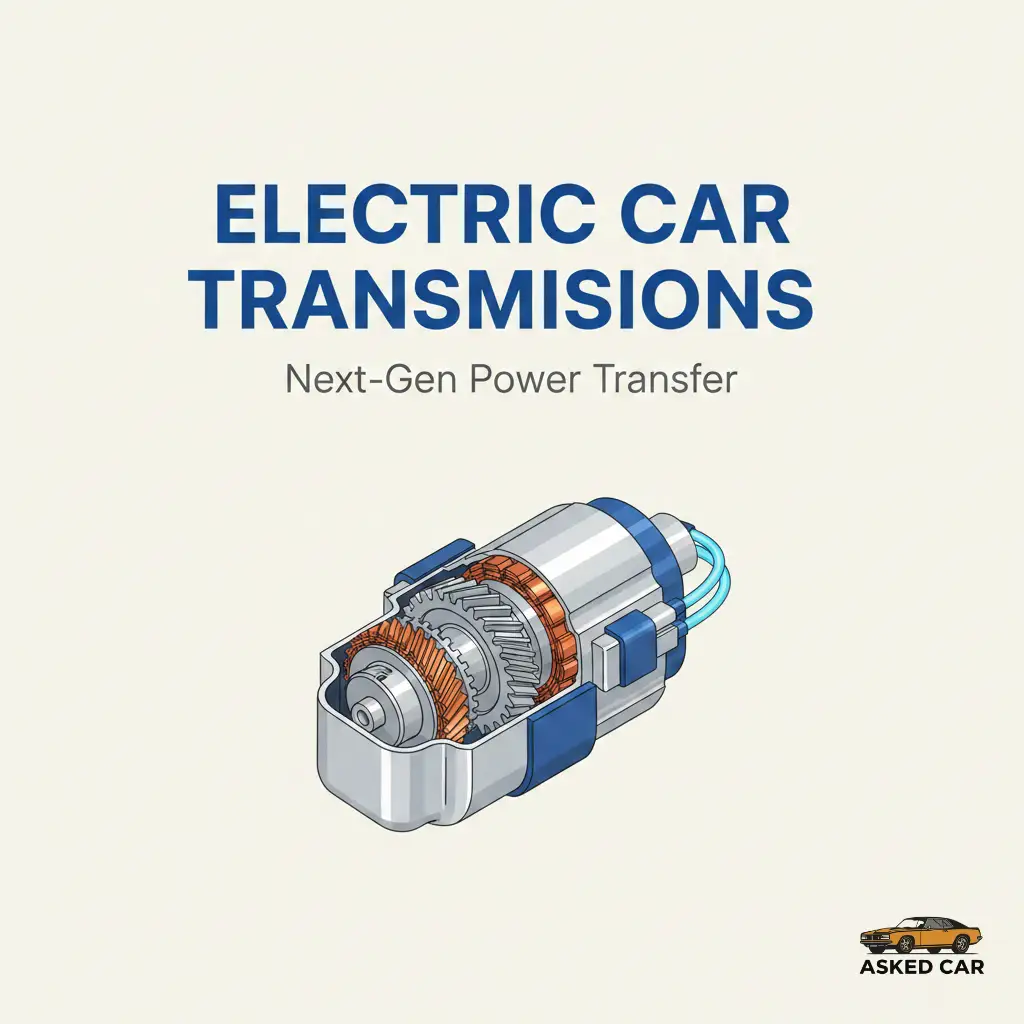
This is where the EV transmission comes in. Its job isn’t to shift gears; its job is to act as a translator. It takes the frantic, high-speed spinning of the electric motor and “reduces” it down to a slower, more powerful rotation that the wheels can actually use.
In most EVs I service, like the Tesla Model 3, Chevy Bolt, or Nissan Leaf, this transmission is a single-speed unit with a reduction ratio of roughly 9:1 or 10:1. That means for every 10 times the motor spins, the wheels spin once.
Inside the case, it’s beautiful in its simplicity. You usually have three main components: an input shaft from the motor, a countershaft with helical gears to handle the reduction, and a differential that splits the power to the axles. There are no clutch packs to burn out, no torque converters to slush around, and no shift solenoids to fail. It’s just hardened steel gears meshing in an oil bath.
The Two-Speed Exception: Porsche’s Autobahn Rocket
Of course, there is always that one manufacturer that has to over-engineer things. In this case, it’s Porsche. If you look at the rear axle of a Taycan or an Audi e-tron GT, you’ll find a genuine two-speed transmission.
Why did they do this? Because electric motors have a dirty secret: as they spin faster (above 100 mph), their efficiency drops off, and torque fades. Since Porsche designed the Taycan to cruise on the German Autobahn at 160 mph, a single-speed gear wasn’t enough.
They added a “First Gear” for violent acceleration off the line, and a tall “Second Gear” that clunks into place around 60 mph to keep the motor efficient at high speeds. It’s a brilliant piece of engineering, but for 99% of daily drivers, it adds weight and complexity that simply isn’t necessary.
The Myth of “Maintenance-Free”
Here is where I have to get real with you. If you look at your owner’s manual, it will likely say the fluid in your reduction gear is “Lifetime Fluid.” In the mechanics’ world, we translate “Lifetime” to mean “The Lifetime of the Warranty.” Once that warranty expires, you are on your own.
I have drained “lifetime” fluid from EVs with 60,000 miles on them, and it often looks like metallic glitter glue. Even though there are fewer moving parts, those gears are under massive torque loads. As they mesh, they shed microscopic metal shavings called swarf. Without a filter (most EV units just use a weak magnet), that metal circulates through the bearings, causing premature wear.
In my shop, I recommend changing the reduction gear fluid every 40,000 to 50,000 miles. It’s a simple drain-and-fill procedure, usually taking less than two quarts of specialized ATF or gear oil. It is the cheapest insurance you can buy for a drive unit that costs $5,000 to replace.
Diagnosing the “Sounds of Doom”
Since EVs are silent, you don’t have engine noise to mask transmission problems. If your reduction gear is failing, it will tell you; you just have to listen.
The Whine: A high-pitched whine that gets louder with speed usually indicates a bearing failure on the input shaft. It sounds like a jet engine taking off in the distance.
The Click: A sharp metallic click when you accelerate or decelerate (regenerative braking) often isn’t the gears themselves, but the splines on the axle shafts drying out. This is a common issue on Nissan Leafs and older Teslas.
The Rumble: If you feel a vibration or rumble through the floorboard that speeds up with the car, we are looking at a differential bearing that has been chewed up by that “lifetime” contaminated fluid.
The Mechanic’s Verdict
So, do electric cars need transmissions? Yes, they do. They are the unsung heroes of the EV revolution, taking 300 horsepower of instant electric fury and putting it to the pavement without exploding. They are simpler, tougher, and more reliable than the transmission in your old gas car, but they are not invincible. Treat them with respect, change that fluid, and enjoy the smooth, shift-free ride that makes going back to a gas car feel like driving a tractor.