Do Electric Cars Need Oil? The Mechanic’s Reality Check
If I had a dollar for every time a new EV owner rolled into my shop and sheepishly asked, “Does this thing actually need an oil change?” I could retire to a beach in Florida. It is a fair question. For a century, “checking the oil” was the holy grail of car maintenance. Now, you open the hood of your Tesla or Mustang Mach-E, and instead of an engine block, you are staring at a plastic trunk or a mess of high-voltage orange cables.
The short answer is no, electric cars do not have engine oil. There are no pistons, no camshafts, and no combustion chambers to lubricate. You can throw away your oil filter wrench.
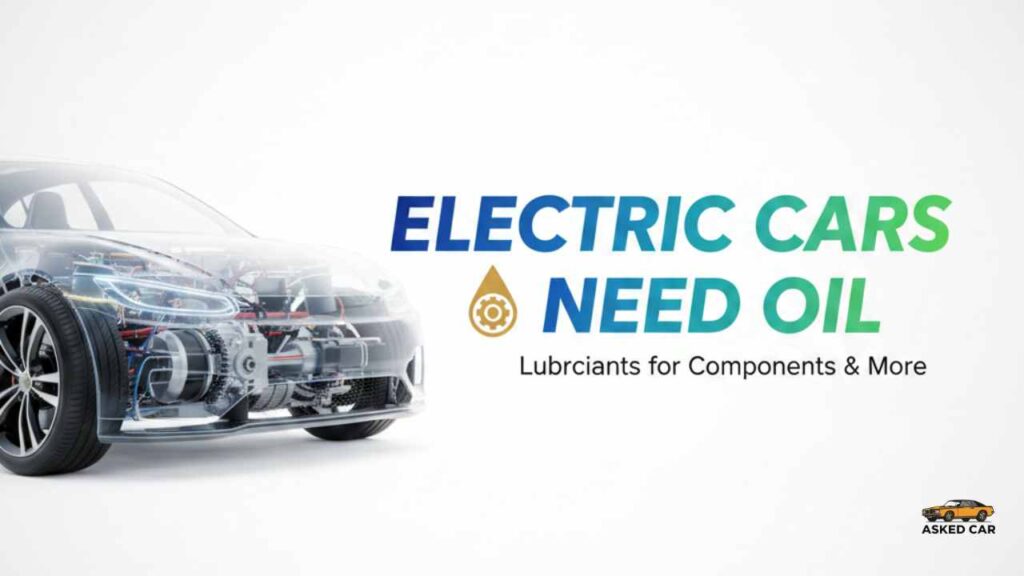
But here is the “brutally honest” part that the dealership brochures often skip: Your EV is still full of fluids, and ignoring them because you bought into the “maintenance-free” hype is the fastest way to turn your $50,000 car into a brick. While you won’t be changing motor oil every 5,000 miles, you absolutely need to maintain the cooling loops, reduction gears, and hydraulic systems that keep that battery from melting down. Let’s break down what is actually sloshing around inside your chassis.
The Hidden Transmission Fluid: Reduction Gear Oil
Most people think EVs are direct drive, but they aren’t. Between your electric motor and your wheels sits a piece of hardware called a single-speed reduction gearbox. This gearbox spins at incredibly high speeds—sometimes up to 20,000 RPM—to convert the motor’s whining speed into torque that actually moves the car. Inside that metal casing, gears are meshing furiously, and they are bathed in a specialized lubricant.
Manufacturers love to slap a “Lifetime Fluid” sticker on this gearbox. In my twenty years of wrenching, I have learned that “lifetime” usually just means “the lifetime of the warranty.” Once you cross that 100,000-mile mark, you are on your own. I have drained “lifetime” fluid from Nissan Leafs and Tesla Model 3s that looked like metallic glitter paint because of all the suspended shavings. If that fluid breaks down, you start hearing a distinct whining noise or a “card in the spokes” clicking sound.
For my customers, I recommend changing this reduction gear oil every 50,000 to 70,000 miles. It is a cheap insurance policy. For a Nissan Leaf, we use Nissan Matic S; for a Tesla, it’s a specific automatic transmission fluid (ATF) depending on the drive unit generation. It drains and fills just like a differential on a truck. Don’t let the dealer tell you it never needs to be touched. Fresh fluid keeps those bearings happy and silent.
Battery Coolant: The Most Critical Fluid You Own
In a gas car, coolant keeps the engine from cracking. In an electric car, coolant keeps the battery from catching fire or degrading. The thermal management system in a modern EV is incredibly complex, pumping fluid through thousands of tiny channels between the battery cells to keep them at a perfect 70-90 degrees Fahrenheit.
Here is where DIYers get into trouble: You cannot just dump generic green antifreeze into an EV. Many modern electric cars, particularly those from Hyundai and Kia, use a specialized Low Conductivity (or Dielectric) Coolant. This fluid is non-conductive, meaning if a hose bursts inside the battery pack, it won’t cause a massive short circuit. I’ve seen horror stories where a well-meaning owner topped off their reservoir with standard auto parts store coolant, and the car’s computer immediately threw a “Check EV System” error because the conductivity sensors went haywire.
We also see issues with coolant crystallization. On some Ioniq 5 and EV6 models, the factory coolant can form tiny crystals that clog the heater core or the water pump, leading to “Refill Inverter Coolant” warnings. If you see white crust building up around your reservoir cap, you need a flush immediately. This isn’t just about topping it up; it’s about flushing the system to prevent blockages that could overheat your inverter.
Brake Fluid: The Hygroscopic Enemy
You might think, “I have regenerative braking, so I don’t use my brakes, right?” Wrong. You still have a hydraulic braking system for emergencies and coming to a complete stop. The problem with brake fluid is that it is hygroscopic, meaning it absorbs moisture from the air over time.
In an EV, because you use the physical brakes less often, the calipers don’t get hot enough to burn off that moisture. This water sits in the lines and can corrode your expensive brake calipers from the inside out. I have had to replace seized calipers on EVs with only 30,000 miles because the slide pins rusted solid from disuse and moisture buildup.
You need to test your brake fluid for moisture content every two years. If it’s above 2%, flush it. Many EVs require DOT 4 or the newer DOT 5.1 fluid, which has a higher boiling point and lower viscosity to work better with the fast-acting ABS systems used in regenerative braking. Do not neglect this just because your brake pads look brand new.
How Often Do You Need Oil in an Electric Car?
If your battery‑electric were an internal‑combustion car, you would have expected a manual or a “check oil every 5,000 miles” routine. EV maintenance is a blend of the mechanical age-old practices and some brand‑specific quirks.
Transmission: Most single‑speed EVs have sealed, maintenance‑free gearboxes. If the gearbox is “sealed‑for‑life,” you’ll never need to replace the transmission fluid. For those who have a serviceable gearbox, a fluid change around a 150,000‑mile interval aligns well with 10W‑30 or 0W‑40 synthetic blends.
Motor Bearings: Usually sealed and designed to last until battery replacement. If you’re a high‑mileage enthusiast, replace the motor bearing grease at 30,000–45,000 miles to keep the rotor smooth.
Differential: 35,000–45,000 miles if you drive a lot of hills or heavy‑towing; otherwise, 60,000 miles works with the standard 75W‑90 oil.
Steering and Braking Fluid: Every 25,000 miles on older hydraulic systems; for EPS, you’re fine until the battery runs out.
In practice, many owners skip all of this until a service bulletin calls for it. That’s why the “oil change” conversation is almost a myth.
The Verdict: Maintenance Hasn’t Gone Away, It Just Changed
So, do electric cars need oil? No. But they need vigilance. The days of the $39.99 oil change special are gone, replaced by less frequent but more specific services. You need to keep an eye on your reduction gear oil to save your drive unit, monitor your low-conductivity coolant to save your battery, and flush your brake fluid to save your calipers.
If you treat your EV like a glorified golf cart and ignore these fluids, you will eventually be the one on the side of the road waiting for a flatbed. But if you respect the chemistry and mechanics under the floorboards, these machines can easily run for hundreds of thousands of miles with fewer headaches than any gas burner I’ve ever fixed.