Do Electric Cars Have Alternators? The Real Science Behind EV Charging
If you’ve popped the hood of a Tesla Model Y or a Ford Mustang Mach-E looking for that familiar, cylindrical alternator, you’re going to be searching for a long time. It’s a common confusion. We’ve spent decades understanding that cars need three things to run: gas, a battery, and an alternator to keep that battery charged.
So, when you make the switch to electric, it’s natural to ask: Do electric cars have alternators?
The short answer is no. But the real answer is fascinating because it reveals exactly how electric vehicles (EVs) manage power differently than the gas guzzlers we grew up with.
As an automotive technician who has transitioned from wrenching on classic muscle cars to diagnosing high-tech EV power systems, I’ve seen this confusion leave drivers stranded. I once had a client bring in a “dead” EV, convinced their main battery had failed, only to find out a $200 lead-acid accessory battery was the culprit.
In this guide, we are going to break down why the alternator is extinct in the EV world, meet its silent digital replacement, and learn how to keep your car’s power system healthy.
Why EVs Ditched the Alternator? Short Answer
An alternator is fundamentally a mechanical device. To work, it needs physical movement.
The Fundamental Difference: Mechanical Energy vs. Electrical Storage
In a traditional vehicle with an Internal Combustion Engine (ICE), the engine spins a crankshaft. That crankshaft is connected to a Serpentine Belt (that rubber belt you sometimes hear squealing), which physically spins the alternator. Inside the alternator, Electromagnetic Induction turns that spinning mechanical energy into electricity to charge your 12-volt battery.
Here is the problem: Electric cars don’t idle. When you are stopped at a red light in an EV, the motor isn’t spinning. If an EV relied on an alternator, your lights and radio would die every time you stopped the car.
The Efficiency Factor
Even if we could attach an alternator to an electric motor, it would be a “parasitic” disaster.
The Physics: You would be using electricity from the main battery to spin a motor, to spin an alternator, to generate electricity to put back into a battery.
The Result: Every step of that process loses energy to heat and friction. It is a thermodynamic nightmare.
Expert Insight: In my shop, I often explain it this way: Putting an alternator on an EV would be like plugging a power strip into itself and expecting it to generate power. It’s just a net loss.
Meet the Replacement: The DC-DC Converter
So, if there is no spinning alternator, how does the radio stay on? Enter the DC-DC Converter.
How the DC-DC Converter Works (The “Silent Alternator”)
This is the brain behind the brawn. The DC-DC converter is a solid-state device, meaning it has no moving parts, which acts as a bridge between your car’s two voltage worlds.
- High Voltage: Your EV has a massive High-Voltage Traction Battery (usually 400V or 800V) under the floor.
- Step-Down: The converter takes that massive voltage and performs a Step-Down Voltage operation.
- Low Voltage: It converts it to a safe 12V to power your wipers, lights, and heated seats.
This process uses a Buck Converter circuit within the Auxiliary Power Module (APM). It is silent, incredibly efficient, and doesn’t care if the car is moving or parked.
Comparison Table: Traditional Alternator vs. DC-DC Converter
| Feature | Traditional Alternator | DC-DC Converter |
| Energy Source | Mechanical (Spinning Belt) | Electrical (High-Voltage Battery) |
| Efficiency | ~50-60% (High heat loss) | 90%+ (Very efficient) |
| Moving Parts | Yes (Bearings, Brushes, Rotor) | No (Solid State Electronics) |
| Maintenance | Belt replacement, bearing failure | Zero maintenance (usually lasts the life of the car) |
| Output Stability | Fluctuates with RPM | Precise Voltage Regulation |
The Critical Role of the 12-Volt Battery in an EV
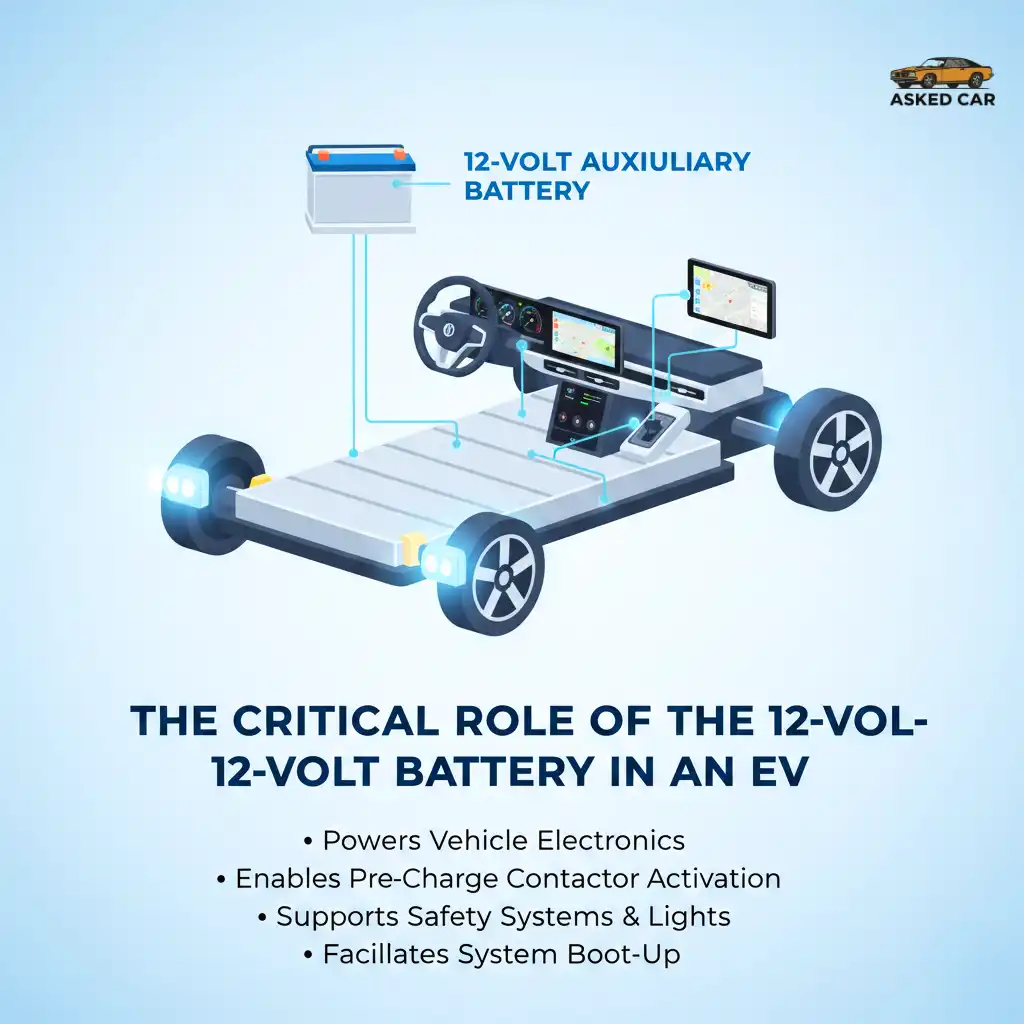
Wait, if there’s a massive battery pack under the floor, why do EVs still have a tiny, old-school 12-Volt Lead-Acid Battery under the hood?
Why Do EVs Still Need a 12V Battery?
It comes down to safety and stability.
Galvanic Isolation: We need to keep the high-voltage systems (which can be deadly) completely separate from the chassis of the car. You don’t want 400 volts running through your door locks.
Parasitic Drain: While the car is “off,” systems like theft alarms and keyless entry need power. A massive traction battery is too inefficient to keep “awake” for these tiny tasks. Low-Voltage Systems handle this efficiently.
The “Chicken and Egg” Problem: The High-Voltage Contactors
This is the most common failure point I see with new EV owners.
Your high-voltage battery is disconnected from the rest of the car when it’s parked for safety. It sits behind heavy-duty switches called High-Voltage Contactors.
The Catch: These contactors are electrically operated relays. They need 12-volt power to close.
The Scenario: If your 12V battery dies, you cannot close the contactors.
The Result: Even if your main battery has 100% charge, the car cannot start because the Battery Management System (BMS) can’t engage the main power. The car is a “brick.“
Charging & Maintenance: Keeping Your EV Powered
Does the 12V Battery Charge While Driving?
Yes. As long as the car is “on,” the DC-DC Converter is active. It pulls energy from the traction battery, converts it, and keeps the 12V system topped up.
Clarification: Many people confuse this with Regenerative Braking. While “regen” captures energy when you slow down, that energy goes to the main high-voltage battery first, not the 12V directly. The DC-DC converter then sips from the main battery as needed.
Does it Charge While Parked? (The Vampire Drain Issue)
Modern EVs are smart. They will periodically wake up to check the 12V status. If it’s low, the main battery engages just long enough to charge it.
However, if you leave your EV unplugged for months, the main battery may drop too low to support this function. This leads to Deep Cycle Battery damage. I recommend using a Trickle Charging device on the 12V leads if you plan to store an EV for more than 4 weeks without plugging it into a wall charger.
How to Jump-Start an Electric Car
Yes, you can jump-start an EV, but you must be careful. You are only jump-starting the 12V system to wake up the computer.
Locate the 12V Battery: It’s usually under a plastic cowl in the “frunk” (front trunk).
Identify Chemistry: Most are Lead-Acid or AGM (Absorbent Glass Mat). Note that newer Teslas use Lithium-Iron-Phosphate (LFP) 16V batteries—do not jump these with a standard gas car; you need a specific 16V capable jumper or you risk damaging the Power Electronics.
Connect Leads: Positive to Positive, Negative to Ground (chassis).
Wait: Let the donor battery provide power for a few minutes. You aren’t “cranking” an engine; you are just giving the computers enough juice to close those High-Voltage Contactors.
Safety Warning: Never, under any circumstances, touch the orange cabling. That is the high-voltage lines. Stick to the small battery terminals.
The Future: Will 12-Volt Batteries Disappear?
The automotive industry is notoriously slow to change, but we are seeing shifts. The 12-volt standard has been around since the 1950s.
The Shift to 48-Volt Architecture
Tesla’s Cybertruck recently made waves by moving to a 48-volt low-voltage architecture. By quadrupling the voltage, they can reduce the current (Amps). Lower current means thinner copper wires. Thinner wires mean less weight and better efficiency.
Eventually, we may see the On-Board Charger (OBC) and Inverter systems integrated so tightly that the separate accessory battery becomes obsolete, but for the next decade, the auxiliary battery is here to stay.
Frequently Asked Questions (FAQ)
Can I use a regular car charger on my EV’s 12V battery?
Generally, yes, provided your EV uses a standard Lead-Acid or AGM battery. However, you must disconnect the battery from the vehicle’s High-Voltage system (usually by disconnecting the negative terminal) before attaching a high-amperage charger to avoid confusing the Battery Management System (BMS).
How long does the 12V battery last in an electric car?
In my experience, they fail faster than in gas cars—often in 3 to 4 years. This is because they undergo different stress cycles and are often smaller than traditional car batteries.
Is the DC-DC converter expensive to replace?
Yes. Unlike a $300 alternator, a DC-DC converter is a specialized piece of Power Electronics. Replacing one can cost between $1,500 and $3,000 depending on the make and model, though they rarely fail compared to mechanical alternators.
Final Thoughts
While electric cars have ditched the alternator, they haven’t defied physics. They still need a way to power the lights, wipers, and computers that keep you safe. The switch from mechanical induction to solid-state Buck Converters represents a massive leap in reliability and efficiency.
But remember: that humble 12-volt battery is still the gatekeeper to your high-tech ride. Treat it well.
Actionable Takeaway: Don’t ignore dashboard warnings regarding the “12V Battery.” Because there is no alternator screeching to warn you of failure, the death of a 12V battery in an EV is often silent and sudden. I recommend having your 12V battery load-tested annually after the vehicle is two years old.
Would you like me to draft a specific maintenance checklist for checking the health of an EV’s 12-volt battery system?