Does Air Conditioning Use Gas or Electricity in a Car? Expert Guides
If I had a dollar for every time a customer asked me, Hey, am I burning gas by sitting here with the AC on?
I’d have retired to a beach house years ago. It’s one of the most common questions I get in the shop, usually right after someone complains about their mileage dropping in July. The answer isn’t a simple yes or no; it depends entirely on what is sitting under your hood.
In my twenty years of wrenching on everything from old-school V8s to modern Teslas, I’ve seen the AC system evolve from a luxury add-on to a critical component of vehicle thermal management. Whether your car sips gas or gulps electrons changes the answer fundamental level. Let’s pop the hood and look at the mechanical reality of what keeps you cool.
The Gas-Powered Reality: The Parasitic Load
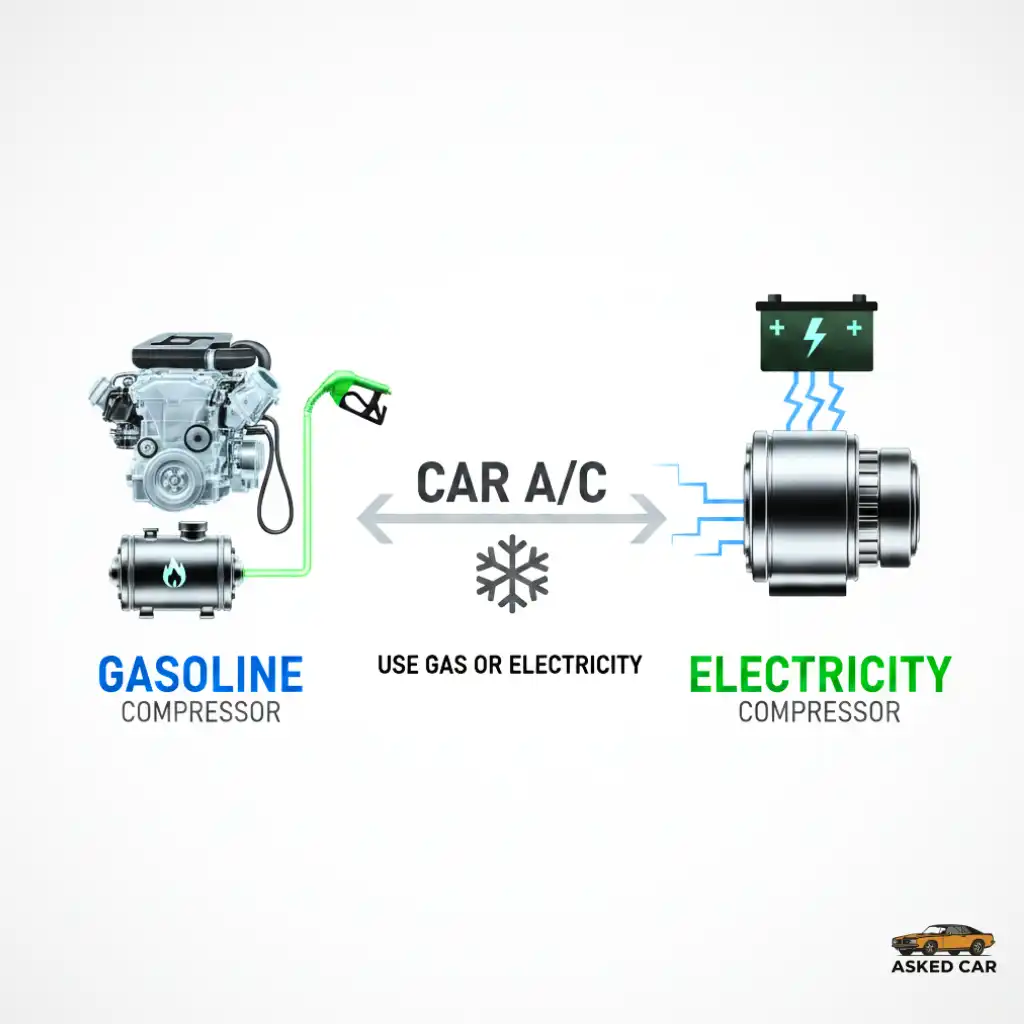
If you drive a traditional internal combustion engine (ICE), think a Honda Civic, Ford F-150, or anything with a tailpipe, your air conditioning 100% runs on gas.
Here is the mechanics of it: Your AC system relies on a heavy piece of iron called the compressor. If you look at the front of your engine, you’ll see a long rubber belt (the serpentine belt) spinning around various pulleys. One of those pulleys belongs to the compressor.
When you press that “AC” button on your dashboard, you are engaging an electromagnetic clutch. If you listen closely outside the car, you will hear a distinct metallic click, followed by the engine’s idle dipping slightly and then surging back up. That click is the clutch locking the compressor pulley to the engine’s crankshaft. Suddenly, your engine isn’t just turning the wheels; it’s forcing a piston inside that compressor to squeeze refrigerant gas.
We call this “parasitic load.” It takes roughly 3 to 5 horsepower to run a compressor. To generate that extra horsepower, your engine’s computer (ECU) opens the throttle body slightly and sprays more fuel. So yes, every second that cold air hits your face, your fuel injectors are working overtime.
The Electric Vehicle (EV) Difference: High-Voltage Cooling
If you drive an electric car like a Tesla Model Y or Chevy Bolt, the rules change completely. Your AC system uses electricity, specifically from the high-voltage traction battery.
EVs don’t have a spinning crankshaft to turn a belt. Instead, they use what we call an e-compressor. This is a high-voltage unit that runs independently of the car’s speed. You can be sitting perfectly still in a parking lot, and the compressor can spin at 5,000 RPM to keep the cabin frigid.
However, while it doesn’t burn gas, it does “burn” range. Running the AC in an EV typically draws between 1 and 3 kilowatts of power. On a long road trip, blasting the AC can reduce your total range by about 5-10%. It’s noticeable, but nowhere near as punishing as the resistive heaters used in older EVs during winter.
The Hybrid Hybrid: The Best (and Worst) of Both Worlds
Hybrids (like the Toyota Prius) are the tricky ones. Early hybrids used belt-driven compressors, meaning the gas engine had to run to give you cold air. If you stopped at a red light and the engine shut off to save gas, the air would get warm and humid instantly. It was miserable.
Modern hybrids use electric compressors powered by the high-voltage battery, just like a full EV. This allows the AC to run while the gas engine is off (like at a stoplight). So, does it use gas? Indirectly, yes. If you sit in a parking lot with the AC blasting, you are draining the hybrid battery. Eventually, the car will sense the voltage drop and kick the gas engine on to recharge the battery. You aren’t burning gas to spin the compressor directly, but you are burning gas to generate the electricity that spins it.
The Windows Down vs. AC Debate: Finally Settled
This is the argument I hear most often: “I’ll just roll the windows down to save gas.”
Physics disagrees with you mostly.
City Speeds (Under 45 mph): Roll the windows down. At low speeds, aerodynamic drag is negligible. Running the AC here puts a heavy load on the engine relative to your speed, killing your MPG.
Highway Speeds (Over 55 mph): Roll the windows up and use the AC. Once you hit highway speeds, your car is fighting a wall of air. Opening the windows turns your sleek sedan into a parachute. The drag caused by the turbulent air creates more resistance than the AC compressor does.
Troubleshooting: What Your AC is Telling You
As a mechanic, I diagnose AC systems with my ears and nose before I ever touch a wrench. Here is what you need to look out for:
The Sweet Chemical Smell: If your vents smell sickly sweet, like maple syrup or ether, you likely have a refrigerant leak (specifically the evaporator core leaking inside the dash).
The “Gym Sock” Smell: This is mold growing on your evaporator core. It happens when condensation sits in the dark, damp box behind your dashboard. The fix? Run your fan on “High” with the AC off for the last 2 minutes of your drive to dry it out.
The Grinding Noise: If you hear a metal-on-metal growl that gets louder when the AC kicks on, your compressor bearing is shot. Ignore this, and the compressor will eventually seize, usually snapping your serpentine belt and leaving you stranded.
Expert Verdict
So, does AC use gas?
- Gas Car: Yes. Directly.
- EV: No. It uses battery range.
- Hybrid: It uses a battery first, then gas to recharge.
My advice? Use the system. Modern compressors are variable-displacement, meaning they are smarter and more efficient than the clunky units from the 90s. The fuel cost is pennies per trip, but the fatigue from driving in a 95-degree cabin is dangerous. Stay cool, keep your cabin filter clean, and if you hear that grinding noise, come see me before it gets expensive.